
At some point, when Elena is invited to a house party by Professor Galiani, Lila accompanies her. Signora Caracci asks her husband, Stefano, to drive them to Galiani’s house, and Lenù sits in the back of the car, staring at the couple’s hands “And for the first time I was struck by the massive wedding rings on their hands, his and hers” (Ferrante 152). Lenù mentions the wedding rings moments before they enter the house- the place where they are going to be examined by Galiani, as well. “Professor Galiani spoke approvingly of long friendships, they’re important, an anchorage, generic phrases uttered as she stared at Lila, who responded self-consciously in monosyllables, and who, when she realized that the professor’s gaze had come to rest on the wedding ring, immediately covered it with her other hand” (Ferrante 155). This sentence, in my opinion, is both a matter of great discussion; but also an example of the famous run-on sentences that Warley mentioned in his article. Warley states that “The denial of logical cohesion, and the denial of historical narrative, often takes the form in Ferrante’s writing of a denunciation of art itself”. He believes that there is so much logic hidden behind all these illogical thoughts and that’s what makes Ferrante’s books hard to resist. In this case, we can see that Elena starts talking about Professor Galiani’s opinion on her long-term friendship with Lila, and immediately changes subject by referring to Galiani’s gaze on Lila’s wedding ring- alla in one, really long sentence. On the other hand, the ring here is really important. As soon as Galiani sees Lila’s ring, she asks her if she’s married and if she’s the same age as Elena. Lila seems embarrassed and ashamed of her marriage at such a young age, that’s why she wants to cover her ring-bearing finger. Elena keeps mentioning that people, including the Professor, did not want to talk to her friend because she was married. It is amazing, however, how a piece of jewelry can change people’s behavior towards somebody, and even making them unwanted. Although what’s interesting, is how Elena starts talking about Stefano’s and Lila’s wedding ring, and they later on become the reason why the guests at the party push Lila away, in a sense. Here, the ring is a symbol of imprisonment for Lila, and Galiani seems to disapprove of her decisions.
Holding on, No Matter What
“But Lila knew how to draw me in. And I was unable to resist: on the one hand I said that’s enough, on the other I was depressed at the thought of not being in her life, of the means by which she invented it for herself. What was that deception but another of her fantastic moves, which were always full of risks? The two of us together, allied with each other, in the struggle against all…, Here was a new adventure, together. Here was how we would take what life didn’t want to give us. Here. Or would I rather that she be deprived of that joy, that Nino would suffer, that both should lose the light of reason and end up not capably managing their desire but being dangerously overwhelmed by it? There was a moment, that night, when, by following her along the thread of her arguments, I came to think that to support her in this undertaking, besides being an important milestone for our long sisterhood, was also the way of manifesting my love–she said friendship, but I desperately thought: love, love, love–for Nino. (Ferrante 274).”
At the very beginning of this passage, Lenu acknowledges that Lila has a way of convincing her to aid her in her “undertaking”. This once again is just another reference to the complex nature and dynamics of their friendship. So often it can be seen that in a way that may be considered unhealthy, a friendship between two people is strained because of the power dynamics that are present in the relationship. Lenu seemingly is reminiscing on how she would feel without Lila in her life and immediately wants to get back to another “adventure” so that she could be reminded of their “partnership” of taking on the struggles of the world together. Supporting Lila in this task is what she considers an important aspect for their relationship. Lenu having the mindset of her and Lila being against the world reveals another layer of their challenging and ever changing sisterhood.
Now you see her, now you don’t.
 “‘Smarginatura’ is a concept that is associated with Ferrante’s novels. In the storyline it’s a physical phenomenon that Lila experiences a number of times in her life, where she feels that she is losing her solid outlines, she is in a way, blurring her boundaries and melting into her surroundings—metaphorically losing her identity.” (Grace Russo Bullaro, co-author of “The Works of Elena Ferrante. Reconfiguring the Margins)
At Professor Galiani’s party we see a Lila remaining within her margins (pg 158). Because regardless of her good station within the rione as Mrs. Carracci she can not break the boundaries of her social standing “she feels voiceless, graceless, depraved of movement, of beauty” “They didn’t want to know anything about her”.(pg 161). “They” are the intellectuals, the educated, the well to do. Lila being soundly rejected tries to turns the table on Lenu’ and all the guest at the party, mocking her and her attempt to “speak like those people” (pg 161). Ferrante gives us a clear view of Lenu’ who is thriving with a great desire to expand and grow beyond her rione and Lila who comes to a brutal understanding that she cannot nor is she welcomed outside of it.
Post 4 – A wrinkle in time

Ferrante breaks the chronology of the story for a second time at the beginning of volume 2. The author makes two jumps at once, one back to 2010 (or maybe now it’s 2011 since it has taken some time to write the first volume) and one that jumps from the wedding in 1960, when Lila and Lenù are 16 years old, to 1966, when Lenù, who reveals her inner thoughts (to the extent she can) to the reader, feels that she and Lila are estranged and their relationship at its worst point. To her surprise, Lila shows up and hands her a well-tied-up collection of personal notebooks, which she must hold for Lila but has to pledge not to read. Of course Lenù begins reading them immediately (could Lila have possibly thought otherwise) and cannot resist continuing, even after they upset her. At some point, after reading, rereading and even memorizing some of what Lila wrote, Lenù dumps the books into the river over a bridge. Thus Ferrante has set up the scenario so that Lenù, writing about Lila, has gained access to Lila’s own descriptions of her though processes and even her revelations of those processes. Or, to be precise, she has her memory of what she read of Lila’s notebooks as her now (2010) more reliable insight into Lila’s own thoughts and feelings, as filtered through her own selective memory. She makes some revisions of Lenù’s own earlier reaction to, for example, Lila’s letter to her when she is on Ischia, which she then evaluated as an act of spontaneous genius. After reading the notebooks she realizes that Lila worked out much of her thinking and all of her formulations before she wrote the letter, that her friend might still be a self-taught genius, but even geniuses have to put in hard work, the result comes not through magic. The notebooks also reveal the utter misery of Lila’s life despite her relative luxury and her ability to make her husband give her money or support her whims, so when Lenù resumes the story she can believably tell it and let all us readers know how Lila feels although Lila is hiding much of those feelings from the others present. The treason of her husband, revealed on the wedding night by his subservience to his own ambitions (and thus to maintaining good relations with the Solaras at Lila’s cost), followed by his rape of a furious, unhappy and unwilling Lila (there is no sign up to now, indeed, up through volume 3, that Lila has any pleasure from sex, only pain and humiliation), has poisoned the marriage. Ferrante is able to do this through her jump through time and by referencing the notebooks.
The conceit of a discovered diary or set of notebooks is a useful one for an author. I put one (it fits the character) in my own novel, though I’m not sure if I’ll keep it. How, when you have one main narrator, to open up another. I got a text from my sister last week wishing that our mother had kept a diary recording her thoughts at various key moments of her life (Mom, like Lenù, was an ace student but forced to go to work at 15 — all three of her children spent at least some time in graduate school, which she helped get us to).
For next class and post 5
Dear All,
Thank you for another great discussion today. For Irini and Christopher: we discussed this article by translator Jenny McPhee in relation to The Story if a New Name. We interpreted the name as monetary status, identity and loss thereof. We discussed the symbolism of the dolls in these novels and in other novels by Ferrante (The Lost Daughter and The Beach at Night). We clarified the structure of the first two volumes and we talked about female protagonists that survive (like Lenù and Olga, in The Days of Abandonment) in contrast to those that perish after abandonment (Dido) or go crazy (Melina and “la poverella”). I suggest that you reach out to somebody who took notes.
We talked about the presentations. You will find a description of what we are going to do under the assignments tab. As I said in class, my impression is that we need to narrow the scope of those presentations about friendship. What is the specific aspect of friendship you want to discuss? Remember that the presentation is not a summary of the plot, but a critical reading supported by a theoretical lens. Your presentation should state your idea and say why it is important. You have to make references to two points in the volumes read so far and refer to at least one secondary source (either read in class or new).
I realized that some of you might not be familiar with how to conduct a research. Please come to the tutoring session, go and see a librarian with your assignment or go to the writing center. These people are there for you. Make an appointment with me if you would rather work with me at a different time.
Finally, here is the assignment for next week: along with the assigned portion of The Story of a New Name, read the blog post by Christopher Warley (follow the link under course material). For your blog posts consider looking for run-on sentences (as described by Warley) or engaging with the topics of his post (speed of narration). In alternative, you might want to discuss something totally new, that we haven’t analyzed in class. For example: why the shoes?
Look forward to reading all your posts. Please try to post on time and if you are writing the meta-post, try to wait until Tuesday so that you have hopefully all of the posts published.
See you next week.
Coloring Within the Margins

Like Lila’s episodes of ‘dissolving margins’, these crucial moments merge into one another from the first novel to the next. Primarily, this occurs when Lila realizes her brother, Rino, is expressing his true colors or rather, the darker, more violent side of him during the fateful night of New Years Eve. She begins to feel nausea, terror and blurriness all at once, unable to comprehend what had possessed her brother and the newfound bestiality of his mannerisms.
Unfortunately for Lila, a similar sentiment returns to her heart after her marriage to Stefano. First of all, it is important to recall the reasons that lead her to marry Stefano in the first place. Similar to Rino, she had noticed generosity, kindness and ambition. She had fallen in love, believing the spectacle that Stefano had put on for the entire community, including her own family. Despite the neighborhood conflicts, Stefano treats everyone around him with courtesy and benevolence, determined to initiate the waves of change and rid of the tense relations of their home unlike the bitter past generations. She becomes filled with admiration and expresses appreciation for the initiative he takes in pushing her father’s shoe business to the top.
However, on her honeymoon night, as she dines with Stefano in an elegant restaurant, the reality of the situation she had placed herself in becomes clear as day, after a series of unfortunate events: “He was a being, now, with whom she felt she could share nothing and yet there he was…He had little or nothing to do with the seller of cured meats who had attracted her, with the ambitious, self-confident, but well-mannered youth…something in and around him had broken,” (Ferrante 37). Similar to the atrocious behavior of Rino on New Years Eve, Lila’s eyes are now able to vividly see the man she has married. He has finally secured his grasp on her and the inner horrifyingly fleshy and selfish man is now in the spotlight. All the positive traits that have previously made up his being have faded and disappeared into nothing. Whatever element has held him together in one piece during his courting period of Lila is now completely and utterly ‘broken’. The margins have given way and the greed and horror that had been hidden in his heart and soul and had been inherited from the feared Don Achille is slowly beginning to pour out.
In analogous terms, prior to the wedding, Lila had seen a figure that had been colored within the lines with gentleness, care and without any errors whatsoever. Now that she has bound herself to him both lawfully and morally, his ‘human’ form is beginning to morph and the carefully chosen theatrical colors are starting to melt away into reality.
This moment of a rude awakening is a sickening reflection of the importance of the physical elements of Lila’s and Elena’s poverty stricken neighborhood as well as the outward appearances of Naples’s women. The confusing maze like trait of their home is an abyss for women who are constantly under the watch and care of their fathers, brothers and husbands. Their beauty or lack thereof are constantly judged and ridiculed, being deemed as prizes for the most ‘manly’ of men. Under such standards, Stefano is now perceived as a real man because he has successfully obtained the most prized and envied female of all under his control. This creates both physical and mental constraints on Lila, further entrapping her into the violence and despair of her neighborhood, unable to find her way out of the maze of wedding vows and empty promises made in her own personal coloring book.
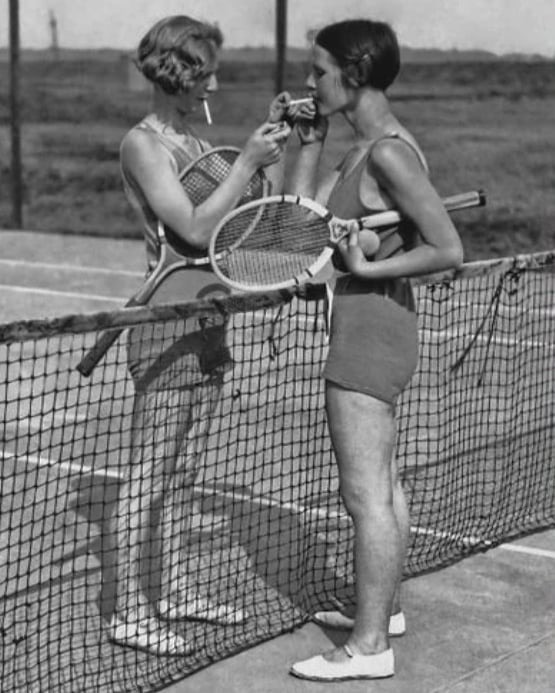
Life long competition.
This picture reminded me of the life long competition between Lenu’ and Lila. Life and friendship is as a tennis match. There is give and take, one must use strategy to overcome an opponent’s strong point and maneuver the game so to play to one’s own strength. In the heat of the game one does not play aganst a friend, they play to win. After the point, game and set is over the competitors (Lenu’ and Lila) take a break return to being friends…….until the next game.
Back to the Future
In the very first chapter of The Story of a New Name, Elena skips ahead a few years before returning to the chronological order. In the leap forward in time, Elena is describing a time when she is distanced from the neighbourhood and her relationship with Lila she sees as being “terrible”, but polite (page 15, The Story of a New Name). Lila has given Lenù journals that she has written about her life the past few years, and the neighbourhood. Another major time the chronology has been disrupted is in the first novel when Elena writes of Lila telling her about the dissolving borders the first time it happened on new years eve 1958, which she does not tell Lenù about until 1980.
Both times, Elena is recounting finding out some inner secrets and confidence of Lila’s. Except for these breaks in chronology, the novels are told exclusively from from Lenù perspective at the time, never revealing future events, so these breaks are very significant. Yet they are never fast forwards to Lenù’s life, they are always about Lila. They reveal very little about the situation or life Lenù is living in that time, sticking with the method throughout the books of only describing her feelings at that certain time, and never disclosing what she knows will happen in the future until it actually does happen.
Be a man Ste’.

While reading the second book “The Story of a New Name”, we can still find traces of time-travelling. Elena keeps going back and forth in time, trying to explain the events that happened in the past as if they were happening right now. However, I do not find this time-travel that interesting. What intrigues me, is Elena’s point of view on the male body and how she perceives male “superiority”.
Lenù refers to the penis as “gross man flesh” (27); but also as something that she desires a lot. She is going out with Antonio, Melina’s son, and they are having all these intimate moments together, where Antonio is always the one receiving pleasure; but not her. She says “I delayed pulling out his sex; I knew that as soon as I did, he would forget about me” (26) and we can tell that Antonio was really “proud” to have a penis and felt like Elena had no needs or whatsoever. On the other hand, we can see that Antonio also depends on her because at some point, while the two of them are fighting, Antonio stops fighting because he thought that Elena wouldn’t want to please him and she “would deny him those few minutes of pleasure” (29).
Simone de Beauvoir in her book “The Second Sex” sets focus on how a male, even as a little boy, is full of himself for being born with a penis because by “having an organ that can be seen and grasped, he can at least partially identify with it” (282).
De Beauvoir says that a man “learns from an early age to take blows, to scorn pain, to keep back the tears. He undertakes, he invents, he dares, he challenges his own manhood” (284), and these are some of the traits we see through Lila’s husband, Stefano Caracci. During their honeymoon, Lila expresses her disgust towards Stefano and admits that she does not want him. Stefano is furious and says to himself “Be a man Ste” (41) and ends up beating up Lila, with the excuse that “she has to learn right away that she is the female and he is the male and therefore she has to obey” (41).
Lila sees herself as one of “Caracci’s possessions” (39) and even though she would often have bruised arms, swollen eyes and purple cheeks, nobody in the stradone would say anything because they thought that “there was someone who knew how to be a man” (45).
Elena does not seem to approve of Stefano’s behavior; but does not seem to detest it, either. She explains that “we had grown up thinking that a stranger must not touch us, but that our father, our boyfriend, and our husband could hit us when they like, out of love, to educate us, to reeducate us” (52). So even if she hates to see her friend in that condition, there is nothing she can do, because this is perceived as “normal” behavior from someone with a penis towards his “lifeless possession”.
Meta-post: The Story of a New Name
In the second novel of the series we have reached the point at which Lila has recently gotten married and is a housewife. There were 5 posts and a major common theme was the idea of Ferrante’s Women. The way in which we have seen just how complex Lila and Lenu’s relationship is displays this concept. As seen in what we have read so far, these two characters seemingly have codependent relationship which may come across as unhealthy at times. Some common points included Lila’s desire to live vicariously through Lenu while she is trapped in marriage and vice versa. The contrasts between the characters is clear throughout the texts. Lila sticks out while Lenu is more prone to blending into the background. However, despite being trapped in marriage, Lila still manages to keep the complexities that make her an individual. We see these characters craving each other’s lives and constantly displaying the layers to their relationship that evolve as they enter different stages of life and forge their own paths. Ferrante shows how seeing their parents in abusive relationships have set the standard for their relationships as well. These are all well thought out points that made me consider how the relationship between Lenu and Lila though not sexual, fulfills them in ways that they may never experience in other relationships.

