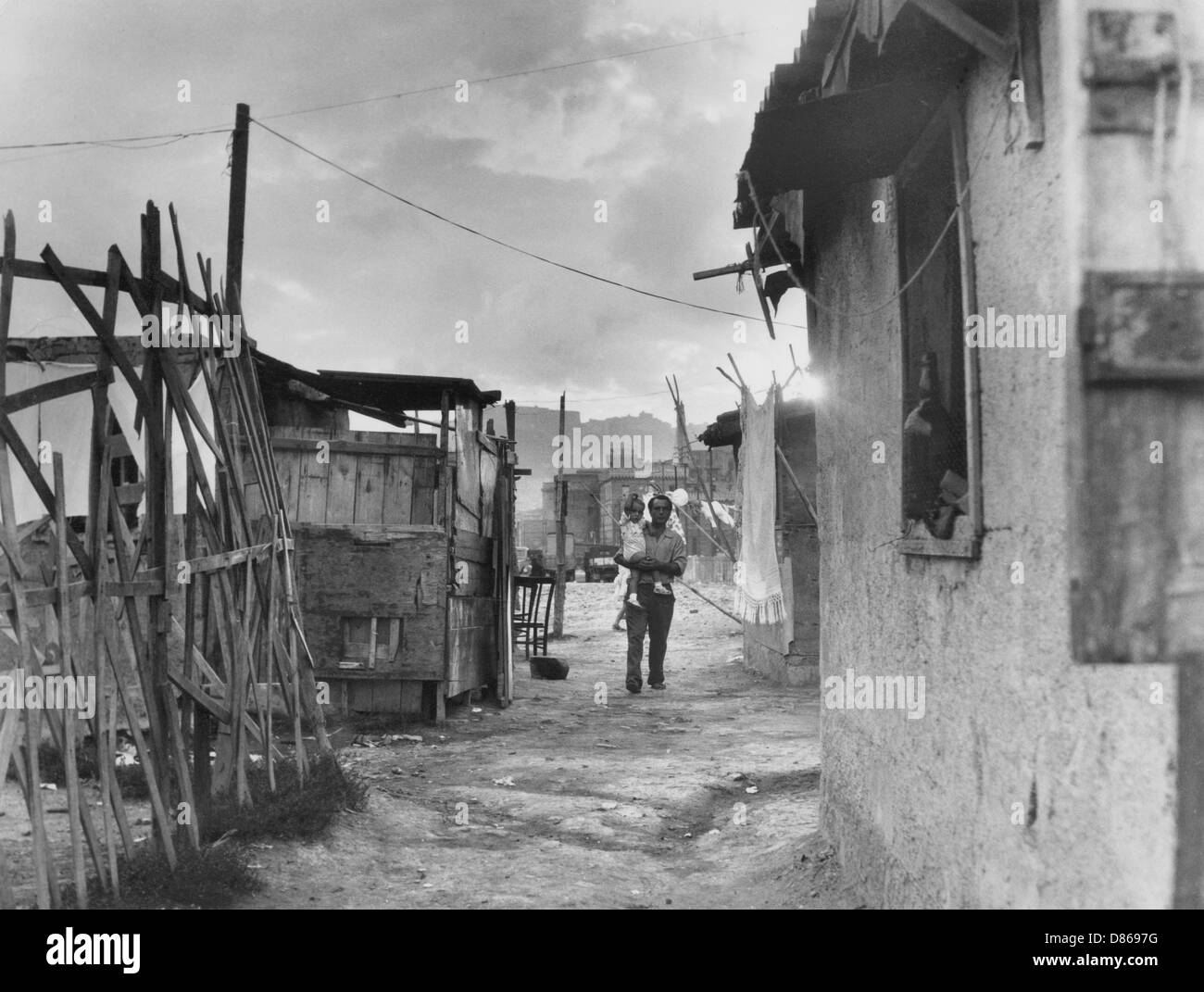
The scene I chose is at the end of the first part of the novel. In the scene, Lila gets thrown out the window by her father for wanting to attend middle school. This scene reveals many vital themes of the novel. Lila’s working-class parents do not see the importance or necessity of Lila continuing her education, despite her unique intelligence. Lila does not want to reconcile with the fact that her father’s decision holds authority and would force her to be stuck in a life that is not intellectually stimulating enough for her. The scene exemplifies the normalcy of violence in the poor Naples neighborhood. This scene is truly heartbreaking because this sort of intense and dangerous behavior from men and fathers is deemed standard and expected, despite how cruel it is. This moment is traumatic for both Lila and Elena. While Lila is is verbally and physically abused by her father to the point of her arms breaking, Elena must watch as a bystander unable to do anything to change the tragic outcome for her best friend. Normalized violence is a prime component of the town, therefore a father is capable and allowed to treat his daughter as such without facing repercussions.
“We were ten, soon we would be eleven. I was filling out, Lila remained small and thin, she was light and delicate. Suddenly the shouting stopped and a few seconds later my friend flew out the window, passed over my head, and landed on the asphalt behind me.”
The world that surrounds the young girls is filled with violence forcing them to grow up and gradually lose pieces of their innocence. Lila who is always incredibly strong-willed and resolute is confronted with a physical strength that is able to overpower her tiny body that reveals a fragileness in a person who is usually indestructible.
One passage that was emotionally charged to me was paragraph 3 on page 70. “In that last year of elementary school, wealth became our obsession. We talked about it the way characters in novels talk about searching for treasure. We said, when we’re rich we’ll do this, we’ll do that. To listen to us, you might think that the wealth was hidden somewhere in the neighborhood, in treasure chests that, when opened, would be gleaming with gold, and were waiting for only us to find them.”
This Passage stood out to me because this instance of relating an education to wealth is something that can be seen not only across genres but in real life as well. There is such an innocence to the thought that those who have not had the chance to grow up with the most stability will be able to reach that “treasure” of financial security and the hope of achieving something better in life. This is just an example of the parallels of fiction and real-life and how these feelings and experiences can be reflected onto and related to the audience.
It is evident that Elena is fascinated about Lina, whether it is about her behavior or intellect. This is contradicting for in the prologue Lina is depicted as frail or easily broke, “You haven’t seen her for a while, Elena, she’s gotten worse: she’s never sleepy, she comes in, goes out, does what she likes.”(Ferrante 19). This does not reflect Lina’s early childhood where she lived in a rough environment but managed to move forward because she had a strong will. The mystery here is how Lina, tough as nails person, managed to become this total opposite. I’m sure all of this will be answered as we go through their story.
There were plenty of on instances when Elena was baffled by Lina’s responses or actions and it merits to be analyze in relation to their evolution. It is still too soon to shed light about their relationship into the reading but from what the text provided it is clear that there is a element of dependency in their friendship. We see it in the prologue, “We’ll see who wins this time, I said to myself.”(Ferrante 23). Here Elena is an adult and she is competing with Lina of this made-up race. Although it’s established that Elena and Lina were apart for some time there is a drive in Elena to catch up or rather to be in terms with Lina. This need to be in the same level as Lina in stems from this unspoken competitiveness that started early childhood, “She began to subject me to proofs of courage that had nothing to do with school.”(Ferrante 54). Elena’s growth is in relation to Lila’s growth. Lila excels at school, Elena pushes herself so she doesn’t fall behind. Although she admits that Lila is too far advanced for her nevertheless she continues to thrive to improve her intellect. Unlike Elena, Lila’s growth is all through her own strengths and she achieved this with little effort. I have yet to see moments with absolute certainty that this effect of growth by means of dependency is the same for Lila. This seems to be one-sided as of right now.
A paragraph I found emotionally charged is found on page 29 at the start of 2. that begins with, “When you haven’t been in the world long, its hard to comprehend…” and ends at the very top of page 30.
This paragraph compares the awareness of life and time a child has versus an adult. I found this paragraph emotionally charged because I feel its something I’m currently transitioning from now that I’m in college. As an adult, you are more aware of the days, yesterday, today and tomorrow but as a child those days seem to blend together. Children typically don’t worry about the yesterdays or tomorrows and really are only aware of the present as their time seems limitless. Adults on the other hand are weighed down by deadlines and time constraints whether its works or bills or household duties. Children live in the moment while the Adult mind expands to worry about things they can’t change in the past as well as things that haven’t even occurred yet in the future. This contrast between child and adult is explained in a way that invokes a sort of “aha” moment about something we rarely think about but at its core is one of the huge distinctions between being a kid and growing up.
“Our world was like that, full of words that killed: croup, tetanus, typhus, gas, war, lathe, rubble, work, bombardment, bomb, tuberculosis, infection. With these words and those years I bring back the many fears that accompanied me all my life” (pg. 33)
“I feel no nostalgia for our childhood: it was full of violence” (pg. 37)
These words might be Ferrante’s words while being inside the protagonist’s (Elena’s) mind; but we can’t ignore the fact that those were a six-year-old’s thoughts on life in Naples. Throughout the novel, there are evident signs of violence, mistreatment, illness, injuries, and an overall chaos that’s taking place in the small neighborhood. Those children grew up seeing blood on the streets, watching their relatives die in front of them; either by an illness that they couldn’t battle against, the cruel that’s war, but even from another neighbor, just because they didn’t have enough money to pay them back, or they didn’t have enough power to stand against them. The narrator mentions all these things as if they were something completely normal-something that little kids should definitely be aware of. I’m not quite sure if things were the same in my village in Greece(or any other village or city) during the same time period, or if this is is something that was going on just in Napoli. It seems as if violence and fear are what gave power to some, in order to take over the poor neighborhood and gain dominance. It is so cruel that children of that age would sit around and play with their toys while people were fighting, shooting each other, and dying next to them. The innocence of those kids had vanished completely.
It’s evident from the beginning that Elena holds an admiration and fearful respect for Lila, engaging in terrifying adventures that she would otherwise never attempt, not only because Lila does so, but also for the sense of excitement and thrill that comes along with them. Up to this point, beginning a new chapter in their education had been something that stimulated both Elena and Lila. Lila’s persistence and intense and even violent arguments with her father eventually results in him giving in to her demands and allowing her to attend middle school. Afterwards, to Elena’s great surprise, although Lila begins attending school, she ends up skipping classes repeatedly. Lila even expresses relief when she becomes ill, simply because it prevents her from attending school. She ultimately ends up failing and afterwards, when Lila’s family decides that she will work alongside her father and brother in the shoe shop, to Elena’s disbelief, she witnesses a newfound pride and delight in Lila whenever she discusses the art of repairing and making shoes. This is emphasized by her deep concentration whenever Elena watches her at work from the shop window. The passion of Lila’s words and actions has several tremendous effects on Elena. Formerly, she would brag about her academic excellence to Lila, expressing an underlying insecurity ever since she had become second to Lila’s extreme intelligence and abilities. Now, not only is Elena struggling to keep up with the difficult and faster pace of middle school education but she also finds herself questioning whether or not this education is necessary or even desirable. She expresses her doubts and sorrow when she narrates, “…seemed to me the best people in the neighborhood. Above all, I came home with the impression that, not spending my days in a shoemaker’s shop, having for a father a banal porter instead, I was excluded from a rare privilege. I began to feel that my presence in class was pointless” (99). She wonders if anything fruitful can result from the constant studying and even when she attempts to apply herself, she does so without a hint of passion and purpose. She now believes that Lila and her family are or should be the most respected and esteemed people in the entire neighborhood because they hold a talent for creating something not only beautiful but also of use to everyone, regardless of status, with the added promise of comfort. Elena desires to be included in having this rare ability and opportunity to learn the ins and outs of shoemaking. However, her own father, unlike Lila’s father does not have an exciting job, according to Elena. These thoughts, however, stem not from a desire to become a successful shoemaker but rather from the wish to discover the brilliance of every occupation that grasps the attention of Lila. In other words, if Lila decides that she has an interest in something, whether it’s to discover a new place, advance her education, or making shoes, Lila’s rollercoaster of passions takes Elena along for the ride.
Yet another effect that this newfound enthusiasm of Lila has on Elena is her overwhelming ‘unhappiness,’ (99) as she calls it. This becomes evident when, almost as a side note, Elena begins describing Lila’s physical traits as she watches her at work from outside the shop. She recounts, “Coming out of school, dazed by unhappiness, I passed Fernando’s shop only to see Lila at her workplace, sitting at a little table in the back, her thin chest with no hint of a bosom, her scrawny neck, her small face,” (99). Elena now not only lacks a yearning to grow in her learning but also has a hint of envy. Instead of solely mentioning how she watches Lila at work, she outlines Lila’s tiny stature and lack of physical maturity, implying that, at the very least, Elena feels superior in this respect because she has, in fact, developed a bosom, and grown in weight, giving her the appearance of a healthy and developing young adolescent. This is a defense mechanism for Elena because she continuously alludes to Lila’s physical characteristics, especially at her lowest points of insecurity throughout the novel. Although not ill-intentioned, this quote expresses Elena’s attempt to undermine the many talents of Lila. As mentioned before, ever since Elena discovered that Lila is intelligent and bold whether it comes to academics or everyday life, she has struggled to keep up with her everchanging interests, realizing that the only aspect of her life in which she feels superior is a physical one.
In the first chapter of the “Childhood” section of My Brilliant Friend, the narrator recounts the encounter which solidified a friendship between her and Lila. “At the fourth flight, Lila did something unexpected. She stopped to wait for me, and when I reached her she gave me her hand. This gesture changed everything between us forever.” (page 29)
Lila and Elena are both on the verge of something terrifying; the feared Don Achille. In their world which only extends to the edges of their neigbourhood, this is the most dangerous figure in their life. Having been warned to stay away constantly, they see him as a monster.
Lila is the one who suggested seeing Don Achille and encourages Lenu to join, yet it should be asked why she has not gone to Don Achille on her own before. Her desire to knock on the door does not seem likely solely to retrieve the dolls back, but to confront this fear. Likely, with Lenu, it is the first time she has felt brave enough. Both are too afraid to confront him alone. While Lila acts as though she is fearless and is the one to suggest knocking on the door: “She thought what we were doing was just and necessary; I.. was there only because she was” (page 29), her offering her hand shows a flaw in her bravado. She offers her hand because she cannot do it alone.
The intenseness of this scene comes not only from what is happening in this passage, but also from what occurs afterwards. This scene changes not only “everything between us forever” (page 29) as the narrator writes, but both of their lives. If their friendship had not been created in this moment of fear, their dynamic may have been different.
The chapter ends without revealing what happens with Don Achilles immediately, perhaps because whether or not the interaction had gone well or horribly, it does not matter or change the friendship that had just been forged on the stairwell.
“Lila listened without saying anything, or almost anything. We asked if she had blood like us and saw her hesitate, then reluctantly answer no. Suddenly she seemed small, smaller than I had ever seen her. She was three or four inches shorter, all skin and bones, very pale in spite of the days spent outside. And she had failed. And she didn’t know what the blood was. And no boy had ever made a declaration to her.” (94)
In the above passage Elena is starting to view Lila in a different light. The girls have drifted apart in the past year and neither has done well in school – Lila failed and Elena barely passed. Elena has also been jealous of the friendship between Lila and Carmela. Now that Elena has gotten her period, she has something to bond with Carmela over that Lila is not a part of. Elena notices that Lila is very small physically, and this gives Elena the idea that she is also better.
Bringing up her small physical stature, her lack of maturity when it came to boys, menstruation, and her failure from school invoke a sense of pity for Lila. I believe that there is a pettiness underlying Elena’s description. When she says that Lila, “Suddenly . . . seemed small, smaller than I had ever seen her,” Elena reveals not Lila’s actual size (Lila is a growing girl, she has to be taller or bigger than she was before) but how she sees Lila in comparison to herself. The sense image of small size summon feelings of pity. What Elena says next is mean. Bringing up that Lila failed school when Elena barely passed is cruel. To judge her based on her development in puberty, which Lila cannot control is cruel. To say that Lila was never asked out is just to show Elena’s dominance. Although Elena is thinking these mean thoughts, she is not saying them outloud. The reader, who is inside Elena’s head, witnesses the pettiness and jealousy going on that makes this an emotionally charged paragraph. But Lila is not witnessing that same pettiness. There is a contrast here between the feelings of the reader and Lila’s feelings. She may not be having the same emotionally charged thoughts of Elena. We do not know what Lila is thinking. It is interesting to note that because we are feeling what Elena is feeling, we are not necessarily having the same reaction as Lila, which is evident is this paragraph.
Choosing one “intense”
passage was really difficult, as so many passages express such intense emotion
and/or action.
In the end I decided
on the incident of the doll throwing (54-55):
“I felt an
unbearable sorrow….But that day I learned a skill at which I later excelled. I
held back my despair…so that Lila said to me, in dialect, ‘You don’t care about
her?’…I was as if strangled by two agonies…the loss of the doll [or] the loss
of Lila.”
The narrator then
throws Nu, Lila’s doll, into the cellar after Tina.
This is the
beginning of the girls’ friendship, and what a beginning.
I see a few themes here: the two girls’ duality, so different yet so alike in their being smarter than just about anyone else (while Lila is indisputably the genius); the dissolving of boundaries (“What you do I do”); the embrace or rejection of theatricality; the competition and spite that exist in every female friendship; a choice that is no choice, because it is only between “two agonies,” when life is bleak and no one gets anywhere because the past is stronger than the future.
Professor Porcelli/Stefania said in class this week that display is a theme for Ferrante. Those who leave don’t like the theatrical. Lenù, the narrator, is definitely in that category, even though you could say that her throwing Nu down the hole is theatrical, just like Lila’s gesture of throwing Tina is. But Lenù’s a pragmatist. She discovers that she has a skill for hiding her feelings, which is going to be key in her survival no matter what, and, what’s more, she’s going to discover that only leaving gives her a joyful feeling of the unknown, a freedom, a feeling so unlike going down into Don Achille’s cellar (75). Yet, without Lila, she would never succeed in leaving.
I want to add one thought about the Benjamin essay. I object to his use of the word “barbarism” (167). Only the petty criminals and camorristi in this novel are barbaric. The reader gets to see the characters and setting from the inside, which Benjamin obviously never got to do when he went to Naples. It’s all just exotic to him.
It was a pleasure to see you again or meet you for the first time. I hope this semester will be a great semester for all of us. Here is what we did today and what we should be thinking about during this week:
We talked about Ferrante’s international success and some criticism against her works. We read and discussed part of Walter Benjamin’s essay on Naples. We introduced some of the recurring topics of the novel (the reflection on writing, women, maternity, Naples). We discussed the requirements for this class.
For next week:
Please read the text by Walter Benjamin (when I say “read” I actually mean “study”) and the first part of My Brilliant Friend (cover to page 119, as stated in our course schedule).
Write your blog post by Monday night at 9pm, using the category “Post 1” and inserting tags of your choice (a good post has at least 2 tags). The “meta-post” is due any time before the next class (please use category “meta-post”).
Think about one semester long project that you would like to pursue (after reading). It is ok if your topic is vague. I just want you to focus on something that you are already interested in. Possible topics include but are not limited to: translation, camorra, meta-literature, women (this are very broad topics that you will need to refine for your presentation or paper).
Think about skills that you want to learn in this course (something that you don’t master yet, but you know is useful in our discipline, that is, literary studies).
If you have questions please comment on this post so that other students can see the discussion.
Need help with the Commons?
Email us at [email protected] so we can respond to your questions and requests. Please email from your CUNY email address if possible. Or visit our help site for more information: