Tag Archives: porosity

Porosity: Private is Public

I chose to write about Benjamin’s idea of porosity and the intermingling of private and public life in Naples. Benjamin describes this particular attribute of Naples as, “… each private attitude or act is permeated by streams of communal life” (174). The line between private and public life in Naples is blurred and this also rings true in the life of Lila Cerullo.

            When Benjamin talks of porosity, he states, “So the house is far less the refuge into which people retreat than the inexhaustible reservoir from which they flood out” (174). In other words, private life bursts out of homes in a way that privacy can no longer exist in the home. Without privacy, that home no longer feels like a place of refuge but more like an extension of street life where anything becomes a spectacle. This reminds me of how Lila explains her summer through the letter she sends Lenù while she is in Ischia. While Lenù is gone, Lila’s home life becomes street life as Marcello Solara continuously invites himself over for dinner at the Cerullo house. Lila not only has to deal with Marcello’s love conquest but also the scrutiny of those around her concerning her and Marcello’s relationship:

“Otherwise, everyone’s anger was unloaded on her: her brothers anger because she had abandoned him to his fate as a slave of their father while she set off on a marriage that would make her a lady; the anger of Fernando and Nunzia because she was not nice to Solara but, rather, treated him like dirt; finally the anger of Marcello, who, although she hadn’t accepted him, felt increasingly that he was her fiancé, in fact her master, and tended to pass from silent devotion to attempts to kiss her, to suspicious questions about where she went during the day, whom she saw, if she had other boyfriends, if she had even just touched anyone” (228).

 Lila’s home life becomes even more public when Marcello buys the Cerullo home a television to which Lenù explains, “… and now half the neighborhood, including my mother, my father, and my sister and brothers, came to the Cerullo house to see the miracle” (228). Lila explains this constant pervasion of her home life as, “… feeling all the evil of the neighborhood around her” (229). Benjamin explains this exact pervasion of the home by stating, “Just as the living room reappears on the street, with chairs, hearth, and alter, so, only much more loudly, the street migrates into the living room” (174). Lila is faced with the porosity of life in Naples in which private and public are one and the same. This characteristic of the rione leaves Lila feeling as though she has no refuge and is simply stuck in the public eye.     

The Porosity of the Female Body

A woman reading a book in the Mergellina area at the foot of Posillipo hill. Naples, 1963.
Mondadori Portfolio—Getty Images

In “Naples,” Benjamin writes of the porosity of private life there: “Similarly dispersed, porous, and commingled is private life” (174). For Benjamin, an upper class Jew from Berlin, the lack of boundaries between the public and the private in Naples must have been stark. Ferrante writes about the porosity of the private and public existence of the families of the neighborhood but goes a step further, writing from the inside–unlike Benjamin, who writes as an observer–about the porosity of the girls’ lives and bodies:

​”I looked at her from the window, and I felt that her earlier shape had broken, and I thought again of that wonderful passage of the letter, of the cracked and crumpled copper [229]. It was an image that I used all the time, whenever I noticed a fracture in her or in me. I knew–perhaps I hoped–that no form could ever contain Lila, and that sooner or later she would break everything again” (Ferrante, 265-6).

Containment and porosity run through the book: Lenù watches Lila from an interior, through the window; the copper pot inexplicably explodes; Lila is a young woman who cannot be contained (though we will see just who tries to do so); women’s lives and bodies are by nature fragmented; their efforts to hold themselves together by controlling and directing outside events, through consulting, scheming, strategizing with each other, are futile. Lenù struggles to simultaneously contain herself and control events by holding in her emotions (joy, moroseness, depression, disappointment) and by ordering and directing events with Lila. Lenù is constrained from acting true to herself, whereas Lila shows her violent emotions. Both are trying to survive but use opposite tactics.

A little later in his observations regarding private life, Benjamin claims, “each private attitude or act is permeated by streams of communal life,” (174) which contrasts starkly with the Northern European custom of dividing public and private. I’ve been thinking that, as a product of an ordered and rigid society, he is idealizing the Neapolitan porosity of the domestic and the street: “Poverty has brought about a stretching of frontiers that mirrors the most radiant freedom of thought” (175), but when I did a little research, I found that he is on the side of experiential knowledge, so he is writing a kind of love letter to Naples (as Paul writes in his Post 3), so now I think he’s willingly giving himself up to his direct experience of Naples and sees the Neapolitans as able to live something that is “radiant,” something he cannot do. Ferrante’s view, on the other hand, is pretty tarnished.
There is some research on the history of privacy in Northern Europe, but I have found nothing on the subject re Southern Europe. Privacy is a way of controlling others’ access to you. Privacy was and is a privilege of the wealthy, the middle class. Working class and poor people, who inhabit smaller spaces and typically live close to their neighbors, have it to a much lesser extent. In the Naples of Ferrante, neither Lenù nor hardly anyone she knows has the luxury of privacy; perhaps Maestra Oliviera is the exception. The whole neighborhood knows when a family explodes into a quarrel. Arguments, beatings, and worse happen in public spaces. And to take it further, to the body: a body cannot be separate from the state of things, and certainly not a female body, which by its nature is open to penetration.

What You Do, I Do

Choosing one “intense” passage was really difficult, as so many passages express such intense emotion and/or action.

In the end I decided on the incident of the doll throwing (54-55):

“I felt an unbearable sorrow….But that day I learned a skill at which I later excelled. I held back my despair…so that Lila said to me, in dialect, ‘You don’t care about her?’…I was as if strangled by two agonies…the loss of the doll [or] the loss of Lila.”

The narrator then throws Nu, Lila’s doll, into the cellar after Tina.

This is the beginning of the girls’ friendship, and what a beginning.

I see a few themes here: the two girls’ duality, so different yet so alike in their being smarter than just about anyone else (while Lila is indisputably the genius); the dissolving of boundaries (“What you do I do”); the embrace or rejection of theatricality; the competition and spite that exist in every female friendship; a choice that is no choice, because it is only between “two agonies,” when life is bleak and no one gets anywhere because the past is stronger than the future.

Professor Porcelli/Stefania said in class this week that display is a theme for Ferrante. Those who leave don’t like the theatrical. Lenù, the narrator, is definitely in that category, even though you could say that her throwing Nu down the hole is theatrical, just like Lila’s gesture of throwing Tina is. But Lenù’s a pragmatist. She discovers that she has a skill for hiding her feelings, which is going to be key in her survival no matter what, and, what’s more, she’s going to discover that only leaving gives her a joyful feeling of the unknown, a freedom, a feeling so unlike going down into Don Achille’s cellar (75). Yet, without Lila, she would never succeed in leaving.

I want to add one thought about the Benjamin essay. I object to his use of the word “barbarism” (167). Only the petty criminals and camorristi in this novel are barbaric. The reader gets to see the characters and setting from the inside, which Benjamin obviously never got to do when he went to Naples. It’s all just exotic to him.

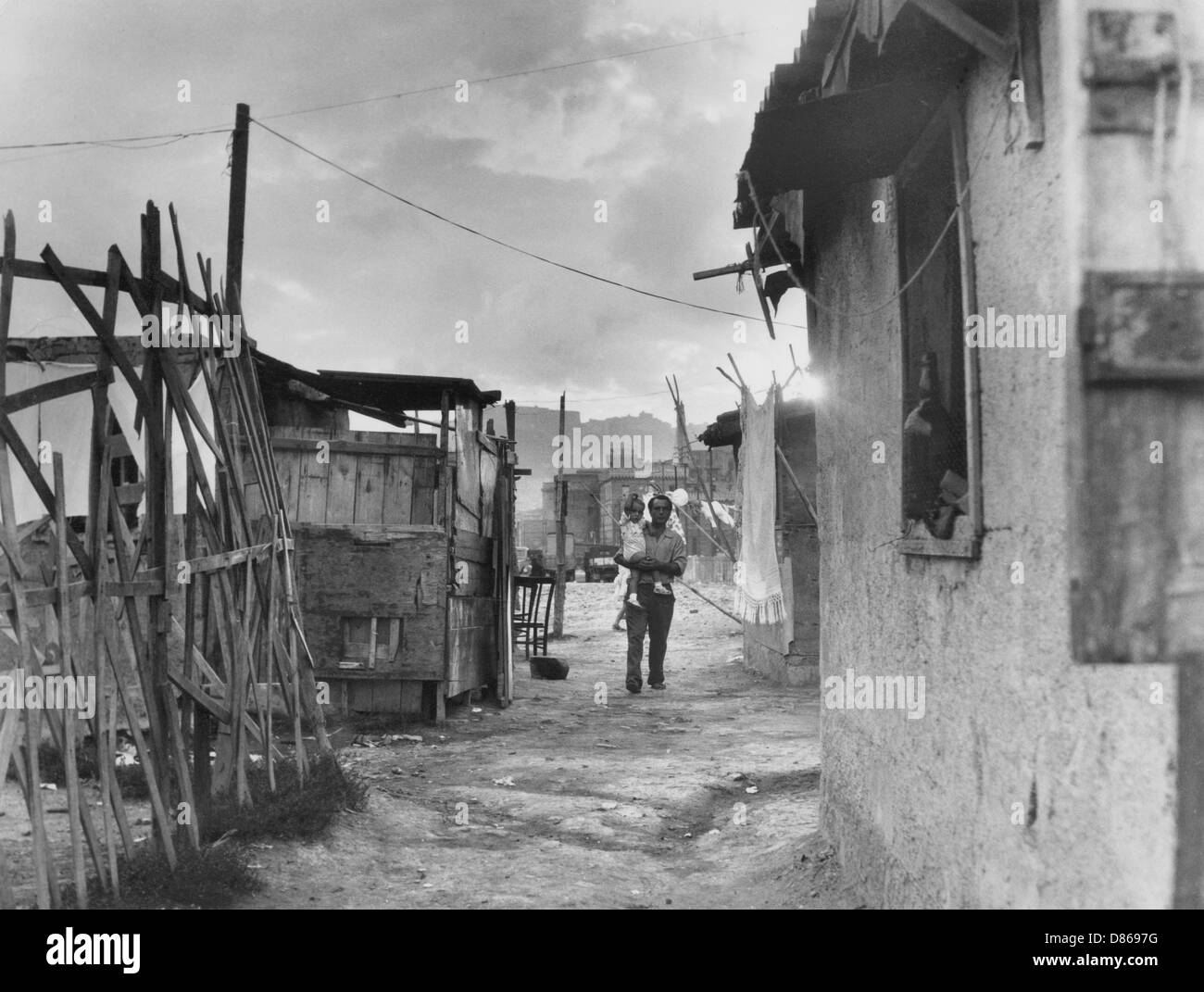
Temporary slum housing, Naples, c. 1960