Tag Archives: friendship

“A Friendship” (Make-Up Post #2)

Elena and Lila from the T.V. show “My Brilliant Friend” based on the first novel of The Neapolitan Quartet of the same name

The Neapolitan Novels have finally come to a close and it is quite saddening to have to be separated from the story of Elena and Lila. Elena concludes this quartet with the final words that many have been anticipating and fearing: “…now that Lila has let herself be seen so plainly, I must resign myself to not seeing her anymore.” (473 Ferrante) In a friendship where two women have been bound so closely to each other in every aspect of their lives from early childhood late into adulthood, it seems almost impossible and suspicious that they will not reunite at least once more, later on in their lives. Even when Elena had attempted to avoid the inevitable influences of Lila, physically and mentally, the latter always found a way to push herself back in. Whether Elena felt grateful or numb to her perseverance, it is evident that Elena has been just as stubborn, herself. Lila has endured numerous unimaginable traumas and perhaps, for this reason, she begins a journey of erasing herself completely, so that she would not have to, one day, recall or read the memories of her ugly past. Perhaps, this is why Lila may feel as if she has been betrayed, for when Elena releases the book on their story of friendship, even after Lila severely denies wanting to have any of it written down, she must feel exposed to the world, knowing that the ugliness and violence of her life will become available in the hands of strangers across the world. But if Lila were a real person, at this very moment, I would like her to know that she need not be afraid of being exposed to the world because, as a reader, I have come to admire her in certain ways, despite her flaws, and I believe that although Lila has said that she is incapable of truly loving anyone, Elena is a person that her heart will always be bound to no matter what.

“Things Fall Apart”

Paola Agosti - Roma, gennaio 1975
Manifestazione femminista per la depenalizzazione dell’aborto, Roma gennaio 1975. Paolo Agosti.
Manifestazione davanti al tribunale per il processo ai violentatori di Claudia Caputi. Roma, 4 aprile 1977. Paola Agosti

“The long story of Elena Greco is marked everywhere by instability…I wanted everything to take shape and then lose its shape” (Frantumaglia, 368).

For me, there is an interweaving between the meta nature of this book; the social and political history that inserts itself into the narrative and into Elena’s life; and Ferrante’s thoughts on the instability or blurring of boundaries (personified by Lila’s experience of smarginatura) and of the past and on Elena’s futile attempt to order her life into a narrative (as with her lived life, Ferrante says that any order or structure in her narrative breaks down in the end).

In the interview with Nicola Lagioia in Frantumaglia, Ferrante says that about Elena’s life there is nothing stable. I think the instability of her life is a stand-in for anyone’s life in contemporary society, the Italian particulars aside. Ferrante speaks of the illusion of an individual alone and separate in the world; she can’t even write without remembering and feeling the presence of others (365). The times in which she lives – which are also the times in which Ferrante and all of us in the class have lived, if only partially – are marked by upheaval, change, and uncertainty. The exterior mirrors the interior, and vice versa. No one who has lived from the end of World War II to the present in Italy has escaped this instability. In life as in fiction.

When Elena’s resolve and the life she so studiously built are in the midst of breaking down, she takes her family to visit Naples with some idea of rescuing her sister Elisa from the clutches of Marcello Solara. The visit (Those Who Leave and Those Who Stay 319-347) does not go as she hopes. No one (an Italian, anyway) can break the “ties to the neighborhood”; Ferrante speaks of those ties reappearing whenever the individual thinks they are gone (367), and for Elena they return with a vengeance: “I realized my voice was taking on the tones of the dialect…that the neighborhood…was imposing its language on me, its mode of acting and reacting…” (328).

And every time Elena resolves to break with Lila – and she’s done this 3-4 times so far – she can’t. After the visit, she tells herself, “I had wanted to become something…only because I was afraid that Lila would become someone and I would stay behind. My becoming was a becoming in her wake. I had to start again to become, but for myself, as an adult, outside of her” (347).

She finds her visits to Mariarosa’s both a frustration and a haven, but that is where she has some new thoughts about the way men are only interested in women to show them that they could do it better. Mariarosa’s genuine interest in her ideas sparks her desire to write again, and she writes a short book. But she cannot share her interest in new feminist ideas with Lila. They no longer understand each other, they can no longer step in and out of each other. Neither has told the truth about her life to the other for years already.

And then, the ultimate happens. Nino reappears. When she runs away with him and takes her very first flight, the book ends with her telling us that the very floor of the airplane, “the only surface I could count on – was trembling.” Nothing is solid anymore. Everything is dissolving: her resolve, her family, her carefully constructed life.

Parasitism

With the date of the midterm presentation approaching I want to center my thinking and analyses on Lila and Lenù’s relationship. I want to narrow my presentation specifically on how Lila is a sort of parasite or disease in Lenù’s life.

An episode in this reading where Lila is seen as a parasite in Lenù’s life occurs through the events following the party at Professor Galiani’s house. At the party, Lenù feels confident, praised and accepted amongst people like her who are educated and strive to be brilliant. Lenù comes to realize after the party at Professor Galiani’s house that she does not want a real relationship with Lila anymore (Ferrante, 169). Lila viciously mocks the manner of the people Lenù strives to be like and this deeply upsets Lenù. All of Lila’s hateful remarks of the night turns Lenù’s joy sour. This immense influence Lila has over Lenù’s emotions is shown through this passage:

“She was so spiteful, all the way home along Corso Vittorio Emanuele, that I was silent, and felt the poison that was transforming what had seemed to me an important moment of my life into a false step that has made me ridiculous. I struggled not to believe her. I felt she was truly hostile and capable of anything. She knew how to set the nerves of good people alight, in their breasts she kindled the fire of destruction” (Ferrante, 163).

Lila has the power to ruin the joys of Lenù’s life. This party is one of the few moments so far that Lenù feels confident being herself; someone who continues to pursue her studies because they matter and will lead to a brilliant future. This party gives her hope and in a single car ride home Lila is able to dismantle that hope and leave Lenù feeling inadequate once again. Lila sucks the hope and joy out of Lenù like a parasite sucks the life out of its host.  

Meta Post 2.0

There were eight posts for this week, and each brought up very interesting points. Some posts discussed things I have been wondering about myself and others brought up points I haven’t even thought of but really appreciated being exposed to.

Starting with the post titled “Luck and Stealth are for Escape Artists,” there was a particular line that really interested me: “As smart as Lila is, its Lenù who is the one who ultimately understands that she has grown too big for the neighborhood.” I had this same thought but didn’t know how to put it in words, but this explains it perfectly. Lila is incredibly smart, one could say smarter than Lenù, but in the end, the one who clings onto the hopes and dreams for something better beyond this neighborhood will prevail and that happens to be Lenù. Another interesting point was how Lenù picks and chooses the thoughts and feelings she shares with Lila. I think this fact gives us a peek into the type of friendship Lenù and Lila share (which in my opinion is a toxic one).

The next post is titled, “Catcalling and Men’s Behavior towards Women.” I liked the comparison between how Lenù talks about boys and how boys do the same. This post highlights the fact that from Lenù’s point of view the way she describes boys seems to come from an innocent place while the looks and catcalls her and her friends receive from men sexualize them. This contrast is important because it brings up a situation in which many women find themselves in today and I feel like any little experience from which we can relate to in this narrative can help us navigate the novel through Lenù’s point of view.

The post titled, “Rivalry and Teamwork,” also had an interesting point stating, “Lila acts as both Lenù’s inspiration, pushing her to do well in school, and her antagonist, making her feel inadequate.” This really got me thinking about the relationship between Lenù and Lila which I’m constantly confused about. I realize that they both wish the best for each other and push each other in positive ways but they can also be incredibly cruel to one another.  This quote explains the complexity of their relationship. This dynamic is one of the main reasons I question their friendship constantly while reading because in my eyes this is a toxic friendship that should end. Co- dependency is also a huge factor of Lenù and Lila’s friendship that I’ve been thinking about while reading as well and I’m glad that it was mentioned in this post and I’d want to focus in on co-dependency in their relationship in future posts.

In the post, “Lila Becomes a Women,” a quote that stuck out to me was, “The way Elena puts herself down when it comes to Lila is almost scary, as if Elena’s personality is connected to Lila’s.” This also alludes to the topic of co- dependency that I think we should all explore more in posts and in discussion. I also liked how Lenù’s view is described in this post as “obsessive teenager” because I think it’s exactly what Ferrante has managed to capture and put on paper even as an adult. I agree that it’s hard to successfully write in this point of view when in the moment you don’t own the mentality of a teenager. An understanding of the view from which the story is told is necessary in following the narrative.

A point I found interesting in the post titled, “A Look, a smile, a slap” was the “it” factor that Lila possesses that makes her a person to chase after. The post states, “I like to think its an energy, a free spirit which cannot be defined by just physical beauty.” The reason everyone always seemed so attracted to Lila did puzzle me but maybe its because it also puzzled Lenù and tit s her lens from which the story is being told. I want to say that don’t even think Lenù entirely knows why she is so drawn to Lila. Maybe the “energy” Lila possesses not only attracts boys to seek relationships with her but also why Lila seeks friendship with her.

The post, “Childhood: Proving Oneself,” focused on the “… very real struggle f carving your own path and finding your identity.” This theme is very characteristic to childhood itself and I also liked the use of “autonomous virtuosity” by ferrante and that it was brought into this post. Lenù in this time of her life like most children is going through the process of figuring out who she is and how she can navigate her strengths to create a better life for herself while also creating her own identity.

“Finding One’s Value Through Competition,” talks about the very evident and constant competition between Lenù and Lila about literally everything whether its grades or boys. The line in this post, “This is the only way that Lenù could attempt to make herself feel valuable and accepted,” is specifically interesting to me because Lenù does seek a lot of her own validation from being better than Lila and when she fails to be better, her identity crumbles.

A contrast to the previous post is titled, “Elena’s Realization: who is more dependent?”. This post talks about the very important time in Lenù’s development where she changes from thinking she needs Lila to succeed to thinking Lila may need her more than she had previously thought. This post describes it as, “Elena is at a place in her life where she finally feels comfortable and not necessarily inferior to those around her, especially Lila.” I do agree that this change in Lenù’s view of herself is very important and shows a great amount of growth.

Overall, I think the majority of these posts talked about the dynamics surrounding Lenù and Lila’s friendship. Reading these posts has made me realize that I find the interworking’s of their relationship the most interesting and the most confusing. I definitely was to focus more on the co-dependency factor of their friendship and how it affects them both, negatively and positively and maybe even delve into how toxic it really is.

Time for the meta-post!

People chose passages about the impersonal violence of Naples, the violence in the girls’ families, and a resulting early loss of innocence; there is the violence that the girls witness or hear about (for example, the murder of Don Achille) and the bodily violence they experience directly. Finally, Lenù and Lila experience intense, violent emotions. Blood makes its appearance in the story Lila fabricates about Don Achille’s death, as well as when Lila threatens Marcello. The girls cannot escape any of this violence, and thus Lila comes up against a fate she cannot escape because, in this place, the father’s word goes. Lila’s brilliance is a bad fit with their environment and social and economic conditions.

There is also the theme of time: that of a child’s – being always in the moment – versus an adult’s. Yet the girls’ early acts, such as going up the stairs to Don Achille’s, create consequences that work on their lives for decades.

Competition is part of the friendship from the beginning. As they hit puberty, Lenù tries to ease her anxiety about Lila’s brilliance by finding ways she is better than Lila, however petty those ways are. Even the book is purportedly written so that Lenù will win “this time” (23). Lenù gets to tell this story; Lila never gets to tell her own story or the story of the friendship. Whoever controls the narrative controls the outcome of the story and how it is told.

In this historical period there are many narratives by authors who are women, oppressed/colonized, young, queer, survivors of genocide, etc., which are readily accepted and can even gain critical acclaim and an enthusiastic readership. The multiplication of narratives is a postmodernist construct and perspective. Yet – at the same time, to quote Stefania! – Lenù, the one who got out, who made a life that is different than what the poverty and narrowness of that slice of society dictated – in other words, the ultimate victor – gets to tell the story, not Lina. In the end Lenù writes the story, while Lina disappears herself. Yet, paradoxically, she cannot disappear from Lenù’s memory (Guzman), and Lenù writes not one but four volumes about them, their friendship, and Naples.

Evolution in Elena by Means Dependency

It is evident that Elena is fascinated about Lina, whether it is about her behavior or intellect. This is contradicting for in the prologue Lina is depicted as frail or easily broke, “You haven’t seen her for a while, Elena, she’s gotten worse: she’s never sleepy, she comes in, goes out, does what she likes.”(Ferrante 19). This does not reflect Lina’s early childhood where she lived in a rough environment but managed to move forward because she had a strong will. The mystery here is how Lina, tough as nails person, managed to become this total opposite. I’m sure all of this will be answered as we go through their story.

There were plenty of on instances when Elena was baffled by Lina’s responses or actions and it merits to be analyze in relation to their evolution. It is still too soon to shed light about their relationship into the reading but from what the text provided it is clear that there is a element of dependency in their friendship. We see it in the prologue, “We’ll see who wins this time, I said to myself.”(Ferrante 23). Here Elena is an adult and she is competing with Lina of this made-up race. Although it’s established that Elena and Lina were apart for some time there is a drive in Elena to catch up or rather to be in terms with Lina. This need to be in the same level as Lina in stems from this unspoken competitiveness that started early childhood, “She began to subject me to proofs of courage that had nothing to do with school.”(Ferrante 54). Elena’s growth is in relation to Lila’s growth. Lila excels at school, Elena pushes herself so she doesn’t fall behind. Although she admits that Lila is too far advanced for her nevertheless she continues to thrive to improve her intellect. Unlike Elena, Lila’s growth is all through her own strengths and she achieved this with little effort. I have yet to see moments with absolute certainty that this effect of growth by means of dependency is the same for Lila. This seems to be one-sided as of right now.

Safety in Numbers

Blog Post 1

In the first chapter of the “Childhood” section of My Brilliant Friend, the narrator recounts the encounter which solidified a friendship between her and Lila. “At the fourth flight, Lila did something unexpected. She stopped to wait for me, and when I reached her she gave me her hand. This gesture changed everything between us forever.” (page 29)

Lila and Elena are both on the verge of something terrifying; the feared Don Achille. In their world which only extends to the edges of their neigbourhood, this is the most dangerous figure in their life. Having been warned to stay away constantly, they see him as a monster. 

Lila is the one who suggested seeing Don Achille and encourages Lenu to join, yet it should be asked why she has not gone to Don Achille on her own before. Her desire to knock on the door does not seem likely solely to retrieve the dolls back, but to confront this fear. Likely, with Lenu, it is the first time she has felt brave enough. Both are too afraid to confront him alone. While Lila acts as though she is fearless and is the one to suggest knocking on the door: “She thought what we were doing was just and necessary; I.. was there only because she was” (page 29), her offering her hand shows a flaw in her bravado. She offers her hand because she cannot do it alone.

The intenseness of this scene comes not only from what is happening in this passage, but also from what occurs afterwards. This  scene changes not only “everything between us forever” (page 29) as the narrator writes, but both of their lives. If their friendship had not been created in this moment of fear, their dynamic may have been different.

The chapter ends without revealing what happens with Don Achilles immediately, perhaps because whether or not the interaction had gone well or horribly, it does not matter or change the friendship that had just been forged on the stairwell.

What You Do, I Do

Choosing one “intense” passage was really difficult, as so many passages express such intense emotion and/or action.

In the end I decided on the incident of the doll throwing (54-55):

“I felt an unbearable sorrow….But that day I learned a skill at which I later excelled. I held back my despair…so that Lila said to me, in dialect, ‘You don’t care about her?’…I was as if strangled by two agonies…the loss of the doll [or] the loss of Lila.”

The narrator then throws Nu, Lila’s doll, into the cellar after Tina.

This is the beginning of the girls’ friendship, and what a beginning.

I see a few themes here: the two girls’ duality, so different yet so alike in their being smarter than just about anyone else (while Lila is indisputably the genius); the dissolving of boundaries (“What you do I do”); the embrace or rejection of theatricality; the competition and spite that exist in every female friendship; a choice that is no choice, because it is only between “two agonies,” when life is bleak and no one gets anywhere because the past is stronger than the future.

Professor Porcelli/Stefania said in class this week that display is a theme for Ferrante. Those who leave don’t like the theatrical. Lenù, the narrator, is definitely in that category, even though you could say that her throwing Nu down the hole is theatrical, just like Lila’s gesture of throwing Tina is. But Lenù’s a pragmatist. She discovers that she has a skill for hiding her feelings, which is going to be key in her survival no matter what, and, what’s more, she’s going to discover that only leaving gives her a joyful feeling of the unknown, a freedom, a feeling so unlike going down into Don Achille’s cellar (75). Yet, without Lila, she would never succeed in leaving.

I want to add one thought about the Benjamin essay. I object to his use of the word “barbarism” (167). Only the petty criminals and camorristi in this novel are barbaric. The reader gets to see the characters and setting from the inside, which Benjamin obviously never got to do when he went to Naples. It’s all just exotic to him.

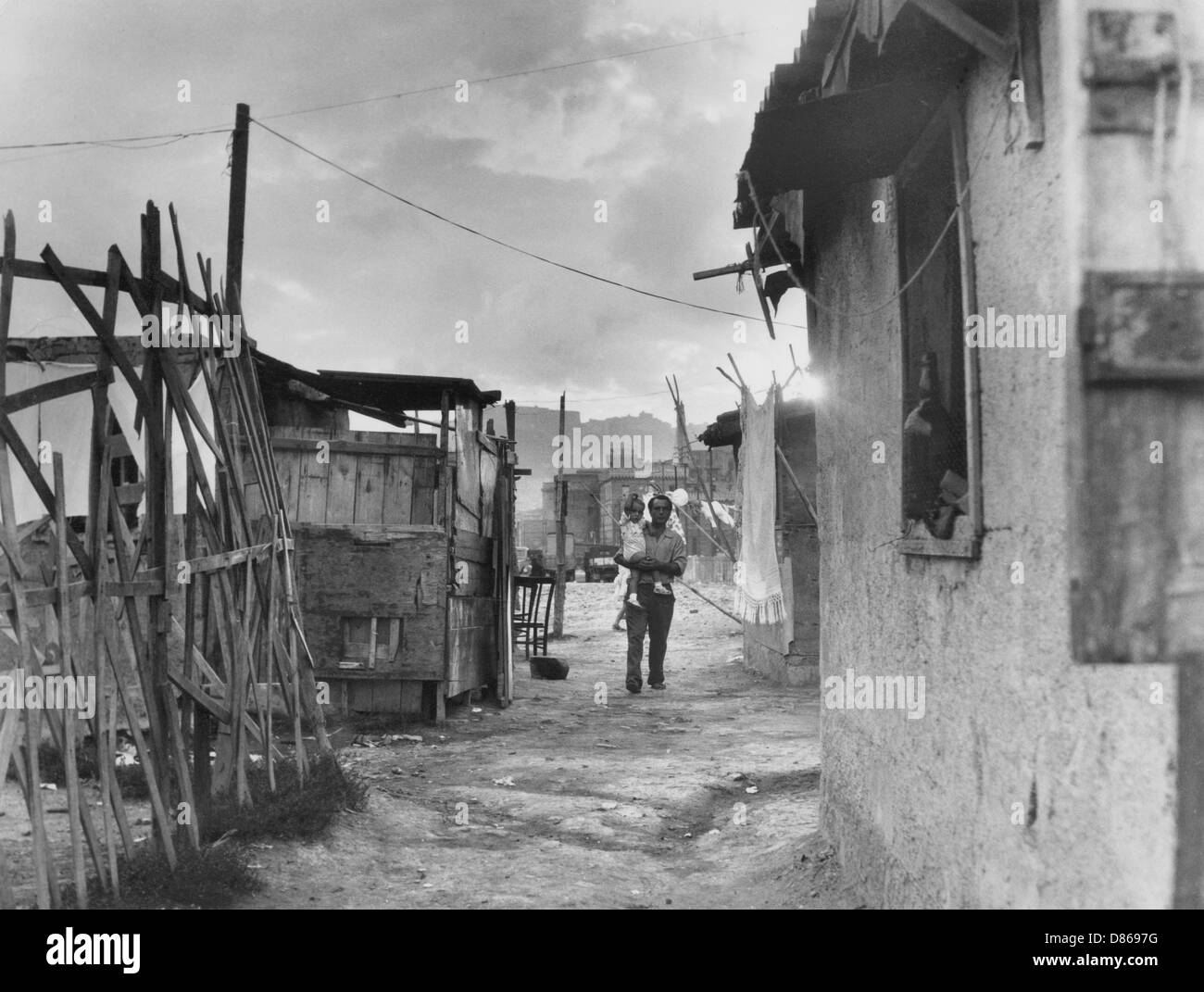
Temporary slum housing, Naples, c. 1960