Please see this flyer about a course in Florence Italy. You can reach out to Professor van Peteghem at [email protected] with any questions about the program.
Here are some common questions about the class.
Winter Course in Florence Q&A
Q: Who is teaching the course?
A: The course is taught by a faculty member from the Italian Program at Hunter. This year Prof. Van Peteghem ([email protected]) is teaching the course.
Q: Do I need to know Italian?
A: The course is taught in English. No knowledge of Italian is required to participate in the program.
Q: How many hours are students in class or at museums/off-site?
A: Class meets every weekday 10am-12:30pm between Friday Jan 3 and Thursday Jan 23. Every week there is one museum/off-site visit scheduled in the afternoon. Students must participate in the afternoon visits.
Q: Is there a lot of homework, reading, free time?
A: This is a 3-credit college course: students will be assigned readings in preparation of each class; there’s a midterm and final exam. But students have most afternoons and the weekends free (see also previous Q), and can plan their study time accordingly.
Q: What sort of lodging is provided?
A: Students will share rooms in a hotel near the center of Florence. Our classroom is also situated in the hotel.
Julie Van Peteghem
Assistant Professor of Italian
Department of Romance Languages
Hunter College
Prof. Lombardi had a family emergency and didn’t fly to NY yesterday, as it was supposed to do. He will probably be in NYC in November. For now the lecture is postponed, but we don’t have a new date yet. I am sorry for the inconvenience.
Please leave a message below to confirm that you have received this note.
Please remember that there is no class on October 9 and 16 (but there is Lombardi’s lecture on the 16). Please take advantage of this break to catch up with the readings or to read ahead or to prepare your presentation. Speaking of presentations (October 30), see the instructions in the page assignments and please notice that in class we discussed the criteria for a good presentation: clarity, specificity, originality of the argument, performance directed at the class (in other words, don’t talk just to the instructor), simple slides with images or bullets points (no text from your presentation, quotations from your sources are allowed) have been voted as the most important criteria for a good presentation.
For October 23 please finish reading The Story of a New Name and read the essay by Emma Van Ness’s in Grace Russo Bullaro and Stephanie V. Love, eds. The Works of Elena Ferrante: Reconfiguring the Margins. Follow the link under materials and download the chapter entitled “Dixit Mater”. Read pages 293-300 for now.
In your Post 6, you can:
1) Reflect on names
2) Reflect on the TV show based on Prof. Lombardi’s lecture
3) Engage with Van Ness’s essay
I look forward to seeing you at the lecture on October 16, at 6.30pm.
If you have any questions, please leave a comment here. Ciao!
Jean Seberg and Jean-Paul Belmondo in Jean-Luc Godard’s Breathless (1960). Rialto Pictures/StudioCanal.
The Prologue closes as Elena begins to type in the middle of the night, is she typing out all four books at one go? We don’t know, but we know it’s impossible. But when I sit to type out a remembered conversation or encounter, of necessity I type quickly, perhaps writing run-on sentences as I go. As Christopher Warley writes, “Ferrante deploys the run-on to create a momentum that is headlong and occasionally breathless but still intimate—here you are, inside the operation of Elena’s head, everything she thinks coming out in the order it occurs to her….” But let’s be clear: Ferrante’s run-ons are clearly stylistic choices or, to be more precise, a style employed to build a cumulative effect with language, with structure, on a sentence level. This is something you can only do by writing purposely, by planning, by rereading and editing your own writing. The prologue, the impulse to sit down to write it all out, is a conceit that I was acutely aware of the first time I read the novel(s). No one can write even a tenth of that at one sitting.
Not only does Ferrante use the comma splice to create her run-ons, she uses semi-colons. Also, in lists, she does not use “and” before the last thing in the list: “…[I]t had become clear to her that her life would forever be Stefano, the grocery stores, the marriage of her brother and Pinuccia, the conversations with Pasquale and Carmen, the petty war with the Solaras” (161).
Here’s an example of Warley’s claim: “[Lila] admitted she had been sure she would be attractive to the males, she always was. Instead she immediately felt voiceless, graceless, deprived of movement, of beauty. She listed details: even when we were next to each other, people chose to speak only to me; they had brought me pastries, a drink, no one had done anything for her; Armando had shown me a family portrait, something from the seventeenth century, he had talked to me about it for a quarter of an hour; she had been treated as if she weren’t capable of understanding” (161).
Lenù is using information she gained from the notebooks (and, I wonder, is she here mimicking Lila’s style of notebook writing, its structure?). But, in the moment, she only knows that after the party Lila spitefully ridicules the evening, the people and the conversation, and even Lenù herself. Thus, from that night, begins Lenù’s “first break and a long separation from Lila” (163). And so Ferrante uses run-ons to signal a transition to a new period in Lenù’s life.
When I tutor I tell beginning writers who use run-ons that they shouldn’t use them because the professor will expect them not to; because they do not know they are writing them; because they have to learn how to structure sentences. But I almost always also say that we speak in run-on sentences, and in fiction and poetry you can do anything you want. The point is to use any construction, device, or strategy consciously as part of your style. Same with fragments, for example.
I use run-on sentences in my creative writing, but not only in my draft. I use them with purpose. I like that they plunge the reader forward and are, as Warley says, “breathless.” They’re good for interiority, which is one (of the many) frame(s) for the whole book. Run-ons don’t give the character time to pause and reflect; as Warley points out, Elena remains caught in the action, in the scene, by means of those sentences. Maybe I started using them from reading Ferrante years ago.
The new section for this week’s reading starts, like the beginning of the book, with a reflection from the future about the past. Elena notes, “How much that evening had hurt her I learned later from her notebooks. She admitted that she had asked to go with me…” (160-161). And Elena continues on about all the things that Lila later admitted in her journals about the night of the dinner party. But in the present Elena describes Lila as “mean” and “treacherous” (161). Elena does not often talk from the future, so the choice to use future knowledge here must be important. Elena wants to show sympathy for Lila. At the time the way Lila acts towards Elena is horrendous and we might not understand why, so we cannot empathize with her. Once we know how Lila felt thanks to the future perspective, specifically, how upset she was at the dinner party, we are able to have more sympathy for her. Elena also chooses to add the future knowledge before even telling the readers what Lila did. These small details show how much love Elena has for Lila even when they are old. Elena works hard to be gracious to Lila and show a kind image of her in her story, but only once she has the perspective of time and age. Sometimes anger is a thing of the present, and kindness is only something that can come with time.
At some point, when Elena is invited to a house party by Professor Galiani, Lila accompanies her. Signora Caracci asks her husband, Stefano, to drive them to Galiani’s house, and Lenù sits in the back of the car, staring at the couple’s hands “And for the first time I was struck by the massive wedding rings on their hands, his and hers” (Ferrante 152). Lenù mentions the wedding rings moments before they enter the house- the place where they are going to be examined by Galiani, as well. “Professor Galiani spoke approvingly of long friendships, they’re important, an anchorage, generic phrases uttered as she stared at Lila, who responded self-consciously in monosyllables, and who, when she realized that the professor’s gaze had come to rest on the wedding ring, immediately covered it with her other hand” (Ferrante 155). This sentence, in my opinion, is both a matter of great discussion; but also an example of the famous run-on sentences that Warley mentioned in his article. Warley states that “The denial of logical cohesion, and the denial of historical narrative, often takes the form in Ferrante’s writing of a denunciation of art itself”. He believes that there is so much logic hidden behind all these illogical thoughts and that’s what makes Ferrante’s books hard to resist. In this case, we can see that Elena starts talking about Professor Galiani’s opinion on her long-term friendship with Lila, and immediately changes subject by referring to Galiani’s gaze on Lila’s wedding ring- alla in one, really long sentence. On the other hand, the ring here is really important. As soon as Galiani sees Lila’s ring, she asks her if she’s married and if she’s the same age as Elena. Lila seems embarrassed and ashamed of her marriage at such a young age, that’s why she wants to cover her ring-bearing finger. Elena keeps mentioning that people, including the Professor, did not want to talk to her friend because she was married. It is amazing, however, how a piece of jewelry can change people’s behavior towards somebody, and even making them unwanted. Although what’s interesting, is how Elena starts talking about Stefano’s and Lila’s wedding ring, and they later on become the reason why the guests at the party push Lila away, in a sense. Here, the ring is a symbol of imprisonment for Lila, and Galiani seems to disapprove of her decisions.
There are many ways to bend time to tell your story.
Ferrante breaks the chronology of the story for a second time at the beginning of volume 2. The author makes two jumps at once, one back to 2010 (or maybe now it’s 2011 since it has taken some time to write the first volume) and one that jumps from the wedding in 1960, when Lila and Lenù are 16 years old, to 1966, when Lenù, who reveals her inner thoughts (to the extent she can) to the reader, feels that she and Lila are estranged and their relationship at its worst point. To her surprise, Lila shows up and hands her a well-tied-up collection of personal notebooks, which she must hold for Lila but has to pledge not to read. Of course Lenù begins reading them immediately (could Lila have possibly thought otherwise) and cannot resist continuing, even after they upset her. At some point, after reading, rereading and even memorizing some of what Lila wrote, Lenù dumps the books into the river over a bridge. Thus Ferrante has set up the scenario so that Lenù, writing about Lila, has gained access to Lila’s own descriptions of her though processes and even her revelations of those processes. Or, to be precise, she has her memory of what she read of Lila’s notebooks as her now (2010) more reliable insight into Lila’s own thoughts and feelings, as filtered through her own selective memory. She makes some revisions of Lenù’s own earlier reaction to, for example, Lila’s letter to her when she is on Ischia, which she then evaluated as an act of spontaneous genius. After reading the notebooks she realizes that Lila worked out much of her thinking and all of her formulations before she wrote the letter, that her friend might still be a self-taught genius, but even geniuses have to put in hard work, the result comes not through magic. The notebooks also reveal the utter misery of Lila’s life despite her relative luxury and her ability to make her husband give her money or support her whims, so when Lenù resumes the story she can believably tell it and let all us readers know how Lila feels although Lila is hiding much of those feelings from the others present. The treason of her husband, revealed on the wedding night by his subservience to his own ambitions (and thus to maintaining good relations with the Solaras at Lila’s cost), followed by his rape of a furious, unhappy and unwilling Lila (there is no sign up to now, indeed, up through volume 3, that Lila has any pleasure from sex, only pain and humiliation), has poisoned the marriage. Ferrante is able to do this through her jump through time and by referencing the notebooks.
The conceit of a discovered diary or set of notebooks is a useful one for an author. I put one (it fits the character) in my own novel, though I’m not sure if I’ll keep it. How, when you have one main narrator, to open up another. I got a text from my sister last week wishing that our mother had kept a diary recording her thoughts at various key moments of her life (Mom, like Lenù, was an ace student but forced to go to work at 15 — all three of her children spent at least some time in graduate school, which she helped get us to).
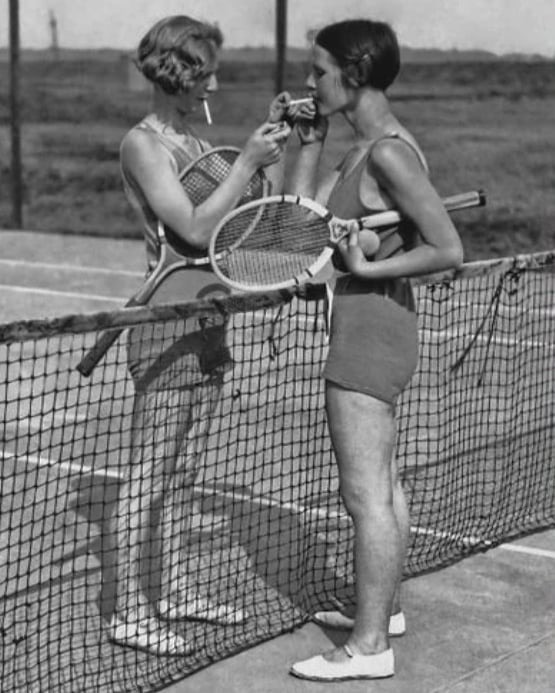
This picture reminded me of the life long competition between Lenu’ and Lila. Life and friendship is as a tennis match. There is give and take, one must use strategy to overcome an opponent’s strong point and maneuver the game so to play to one’s own strength. In the heat of the game one does not play aganst a friend, they play to win. After the point, game and set is over the competitors (Lenu’ and Lila) take a break return to being friends…….until the next game.
While reading the second book “The Story of a New Name”, we can still find traces of time-travelling. Elena keeps going back and forth in time, trying to explain the events that happened in the past as if they were happening right now. However, I do not find this time-travel that interesting. What intrigues me, is Elena’s point of view on the male body and how she perceives male “superiority”.
Lenù refers to the penis as “gross man flesh” (27); but also as something that she desires a lot. She is going out with Antonio, Melina’s son, and they are having all these intimate moments together, where Antonio is always the one receiving pleasure; but not her. She says “I delayed pulling out his sex; I knew that as soon as I did, he would forget about me” (26) and we can tell that Antonio was really “proud” to have a penis and felt like Elena had no needs or whatsoever. On the other hand, we can see that Antonio also depends on her because at some point, while the two of them are fighting, Antonio stops fighting because he thought that Elena wouldn’t want to please him and she “would deny him those few minutes of pleasure” (29).
Simone de Beauvoir in her book “The Second Sex” sets focus on how a male, even as a little boy, is full of himself for being born with a penis because by “having an organ that can be seen and grasped, he can at least partially identify with it” (282).
De Beauvoir says that a man “learns from an early age to take blows, to scorn pain, to keep back the tears. He undertakes, he invents, he dares, he challenges his own manhood” (284), and these are some of the traits we see through Lila’s husband, Stefano Caracci. During their honeymoon, Lila expresses her disgust towards Stefano and admits that she does not want him. Stefano is furious and says to himself “Be a man Ste” (41) and ends up beating up Lila, with the excuse that “she has to learn right away that she is the female and he is the male and therefore she has to obey” (41).
Lila sees herself as one of “Caracci’s possessions” (39) and even though she would often have bruised arms, swollen eyes and purple cheeks, nobody in the stradone would say anything because they thought that “there was someone who knew how to be a man” (45).
Elena does not seem to approve of Stefano’s behavior; but does not seem to detest it, either. She explains that “we had grown up thinking that a stranger must not touch us, but that our father, our boyfriend, and our husband could hit us when they like, out of love, to educate us, to reeducate us” (52). So even if she hates to see her friend in that condition, there is nothing she can do, because this is perceived as “normal” behavior from someone with a penis towards his “lifeless possession”.
“ Stefano hears a voice from the past and maybe even before he was born. The order was be a man Stef, either you’ll subdue her now or you’ll never subdue her”.(Pg 41). We could assume the one of the voices he heard in the past was that of his father Achille. But Ferrante writes “even before he was born”. It’s perhaps since the beginning of time that boys are raised to have a sense of physical dominance “He is aware of his body as a means of dominating nature and as a weapon for fighting; he takes pride in his muscles as in his sex.” (Beauvoir, The Second Sex). It is with his sex that Stefano physically conquers what he believes is his right to take from Lila because of the traditional vows which were made in church and his upbringing with as man.The rione did not sympathize with Lila but with Stefano, “there was someone who knew how to be a man.” (pg 45)
Lenù though not in love with Antonio is brimming with sexual desire. She makes herself fully available to Antonio. Lenù does not care “about being pregnant without being married, about sin, about divine overseers in the cosmos above or the Holy Spirit” (pg 26). This confuses Antonio and he refuses to have intercourse with her because “I want to do it the way it’s done with a wife, not like this”. (Pg 27).
Both Antonio and Stefano are misogynistic in their behavior. One, a man who takes what he wants because he has the physical power to do so and the other who withdraws the giving of pleasure to another and only pleased with pleasure to himself.
For Lenù and Lila they too had grown up seeing their fathers beat their mothers and that was fine because their boyfriends, husbands or fathers could beat them out of love, to educate or re-educate them. (Pg 52)
Post 4
Need help with the Commons?
Email us at [email protected] so we can respond to your questions and requests. Please email from your CUNY email address if possible. Or visit our help site for more information:

 Dear All,