Author Archives: Julie Anne Forgione

Time for the meta-post!

People chose passages about the impersonal violence of Naples, the violence in the girls’ families, and a resulting early loss of innocence; there is the violence that the girls witness or hear about (for example, the murder of Don Achille) and the bodily violence they experience directly. Finally, Lenù and Lila experience intense, violent emotions. Blood makes its appearance in the story Lila fabricates about Don Achille’s death, as well as when Lila threatens Marcello. The girls cannot escape any of this violence, and thus Lila comes up against a fate she cannot escape because, in this place, the father’s word goes. Lila’s brilliance is a bad fit with their environment and social and economic conditions.

There is also the theme of time: that of a child’s – being always in the moment – versus an adult’s. Yet the girls’ early acts, such as going up the stairs to Don Achille’s, create consequences that work on their lives for decades.

Competition is part of the friendship from the beginning. As they hit puberty, Lenù tries to ease her anxiety about Lila’s brilliance by finding ways she is better than Lila, however petty those ways are. Even the book is purportedly written so that Lenù will win “this time” (23). Lenù gets to tell this story; Lila never gets to tell her own story or the story of the friendship. Whoever controls the narrative controls the outcome of the story and how it is told.

In this historical period there are many narratives by authors who are women, oppressed/colonized, young, queer, survivors of genocide, etc., which are readily accepted and can even gain critical acclaim and an enthusiastic readership. The multiplication of narratives is a postmodernist construct and perspective. Yet – at the same time, to quote Stefania! – Lenù, the one who got out, who made a life that is different than what the poverty and narrowness of that slice of society dictated – in other words, the ultimate victor – gets to tell the story, not Lina. In the end Lenù writes the story, while Lina disappears herself. Yet, paradoxically, she cannot disappear from Lenù’s memory (Guzman), and Lenù writes not one but four volumes about them, their friendship, and Naples.

What You Do, I Do

Choosing one “intense” passage was really difficult, as so many passages express such intense emotion and/or action.

In the end I decided on the incident of the doll throwing (54-55):

“I felt an unbearable sorrow….But that day I learned a skill at which I later excelled. I held back my despair…so that Lila said to me, in dialect, ‘You don’t care about her?’…I was as if strangled by two agonies…the loss of the doll [or] the loss of Lila.”

The narrator then throws Nu, Lila’s doll, into the cellar after Tina.

This is the beginning of the girls’ friendship, and what a beginning.

I see a few themes here: the two girls’ duality, so different yet so alike in their being smarter than just about anyone else (while Lila is indisputably the genius); the dissolving of boundaries (“What you do I do”); the embrace or rejection of theatricality; the competition and spite that exist in every female friendship; a choice that is no choice, because it is only between “two agonies,” when life is bleak and no one gets anywhere because the past is stronger than the future.

Professor Porcelli/Stefania said in class this week that display is a theme for Ferrante. Those who leave don’t like the theatrical. Lenù, the narrator, is definitely in that category, even though you could say that her throwing Nu down the hole is theatrical, just like Lila’s gesture of throwing Tina is. But Lenù’s a pragmatist. She discovers that she has a skill for hiding her feelings, which is going to be key in her survival no matter what, and, what’s more, she’s going to discover that only leaving gives her a joyful feeling of the unknown, a freedom, a feeling so unlike going down into Don Achille’s cellar (75). Yet, without Lila, she would never succeed in leaving.

I want to add one thought about the Benjamin essay. I object to his use of the word “barbarism” (167). Only the petty criminals and camorristi in this novel are barbaric. The reader gets to see the characters and setting from the inside, which Benjamin obviously never got to do when he went to Naples. It’s all just exotic to him.

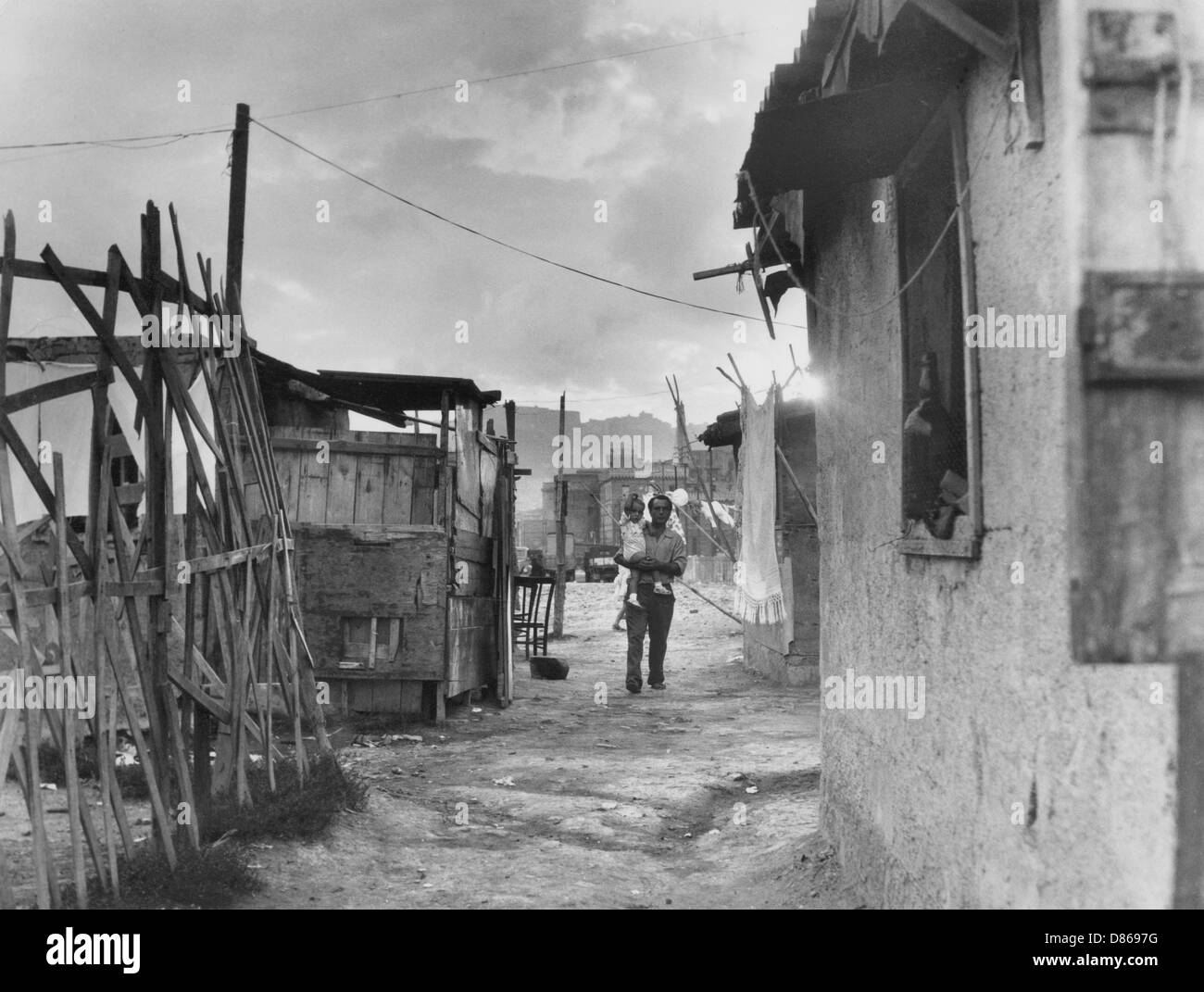
Temporary slum housing, Naples, c. 1960